See better, work better. That’s the spirit of Kanban. A simple, visual method that transforms the way you work every day. No need for complex tools or major overhauls. Just a few columns, some cards, and a new way to manage activities.
But behind this apparent simplicity lies real power. Kanban isn’t just about organizing sticky notes. It helps regulate workflow, improve collaboration, and reduce overload. How can you adopt it effectively? And how can you make it a driver of continuous improvement in your business? Let’s take a look.
Understanding the Essence of Kanban
The word Kanban comes from Japanese and literally means “visual card.” Originally used in the automotive industry, it quickly spread to all sectors — from services to IT, from administration to HR.
Its principle: make work in progress visible. See tasks, their progress, their bottlenecks. To decide better, prioritize better, and collaborate better.
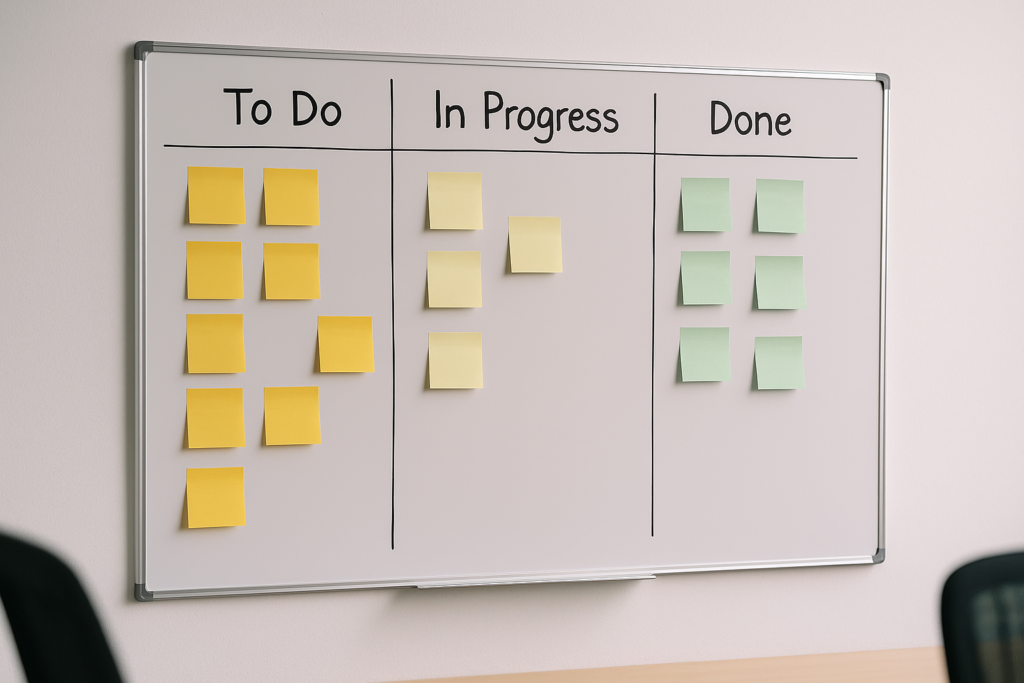
A Kanban board? Just a few columns: To Do, In Progress, Done. Cards that represent tasks. And one golden rule: limit work in progress to avoid bottlenecks. Nothing more, nothing less.
First Lever: Make the Workflow Visible
This is the foundation of Kanban: bringing invisible work to light. Too often, tasks pile up in inboxes, Excel sheets, or in people’s heads. The result: stress, delays, loss of visibility.
With a Kanban board, everything becomes clear. You can see what’s in progress, what’s stuck, and what’s moving forward — at a glance.
This shared visibility changes everything. It aligns teams, prevents misunderstandings, and makes decision-making easier. It also helps anticipate, adjust, and decide together.
Second Lever: Limit Work in Progress
One of the most powerful — and counterintuitive — principles of Kanban. To go faster, you sometimes have to… slow down.
Limiting the number of tasks in progress helps you focus better, finish before starting something new, and reduce lead times.
It’s the opposite of multitasking, which often leads to distraction. With clear limits (for example, no more than 3 tasks per person at the same time), the workflow becomes smoother and more predictable.
The benefits are immediate: less waiting, fewer errors, more satisfaction.
Third Lever: Identify Blockages
Another strength of Kanban: it highlights what’s slowing you down.
A card stays stuck in a column? That’s a signal. It could be waiting for approval, dependent on another department, or facing a technical issue… Whatever the case, what matters is that the problem is no longer hidden.
Thanks to this transparency, teams can act quickly, unblock, and readjust. The board becomes a real-time management tool.
Little by little, you learn to handle the unexpected better, make processes more reliable, and eliminate recurring pain points.
Fourth Lever: Adapt Continuously
Kanban isn’t static. It evolves with your needs. The board can be enriched with new columns (e.g., “Under Review,” “Awaiting Approval”), include indicators (time, volume), or be adapted to each team.
But be careful: the goal isn’t to overcomplicate. Kanban remains a lightweight tool. The idea is to evolve the system with the teams, at their pace, according to their reality.
It’s this ability to adapt that makes it such a powerful tool for continuous improvement.
Some Practical Examples
In a marketing team, a Kanban board helped distribute campaigns more evenly among members. Result: fewer emergencies, more peace of mind.
In an IT department, using a shared Kanban helped identify requests waiting for approval. Result: a 20% time saving on deliveries.
In an HR department, a simple whiteboard was set up to track hiring stages. Result: fewer oversights, smoother processes.
Simple, concrete, and effective examples.
What to Avoid
Three common pitfalls to watch out for.
Rushing into full digitalization
It’s tempting to jump straight into a digital tool, especially with so many available today. But that’s not always the right move.
A physical Kanban — on a wall, whiteboard, or with sticky notes — has the advantage of being visible to everyone, all the time. It invites spontaneous interaction and participation.
Digital tools can come later, once teams understand the method, the rules, and its value. The most important thing isn’t the tool — it’s the usage.
Letting it stagnate
A Kanban board is not decoration. It should be alive, dynamic, and used daily.
If cards don’t move and no one checks it, it loses all purpose.
To keep it active, use simple rituals: a quick daily or weekly check-in, discussions about blockages, and regular updates.
These moments of synchronization are what give Kanban its value. Without them, it becomes just another forgotten tool.
Believing it’s a magic wand
Kanban is not a miracle solution. Just installing a board won’t make problems disappear.
In fact, it will highlight dysfunctions: bottlenecks, forgotten tasks, unclear dependencies. And that’s exactly why it’s valuable.
But you must be willing to see these problems, talk about them, and fix them. Kanban doesn’t erase — it reveals. And that’s what makes it powerful… provided you act on it.
How to Start Simply
No big project needed. Start small.
Choose one team, one process, one activity. Set up a board, even a basic one.
Identify the tasks to track, define a few columns, add your first cards.
Test. Adjust. Involve the team.
Set up a short weekly check-in: 15 minutes to review the board, spot blockages, and celebrate progress.
And above all: keep it simple, useful, and alive.
The Role of the Manager
A good Kanban manager is not the one who controls everything — but the one who facilitates the flow.
They help visualize, regulate, and arbitrate. They support the team in managing priorities. They recognize improvement efforts.
And above all, they create a climate of trust — where anyone can flag a blockage without fear, suggest an adjustment, or take the initiative.
They ask more questions than they give answers. They notice weak signals. They encourage experimentation, even if imperfect.
Key Takeaways
- Kanban is a simple visual method to streamline work
- It helps you see better, prioritize better, and collaborate better
- Its pillars: visibility, regulation, and adaptability
- It’s not imposed — it’s built with the team
- Better an imperfect board that’s used than a perfect tool that’s ignored