Avoiding mistakes before they happen—that’s the essence of Poka Yoke. It’s not about complicated gadgets or burdensome constraints, but about a simple and effective logic to make processes reliable and ensure quality every day.
The term comes from Japanese: poka means “unintentional error,” and yokeru means “to avoid.” The idea is straightforward: design processes so that mistakes are impossible—or at least immediately visible.
This philosophy has proven its worth in manufacturing but can just as easily transform services, administration, logistics, or even the digital world.
Why Poka Yoke?
One fact is undeniable in most organizations: human error exists, and always will.
A wrong click, a missing signature, a part assembled backwards, a wrongly filled field… Small mistakes can sometimes cost a lot: delays, waste, dissatisfied customers, or loss of trust.
Training, reminders, and awareness are useful, but relying solely on vigilance or memory is unrealistic. Poka Yoke offers another approach: instead of fixing errors afterwards, prevent them from happening in the first place.
Its goals are clear:
- Reduce the risk of errors.
- Ensure quality without adding heavy controls.
- Simplify employees’ work.
The Principle: Make Errors Impossible
Poka Yoke relies on two complementary approaches:
- Preventing the error: design the system so the error cannot be made.
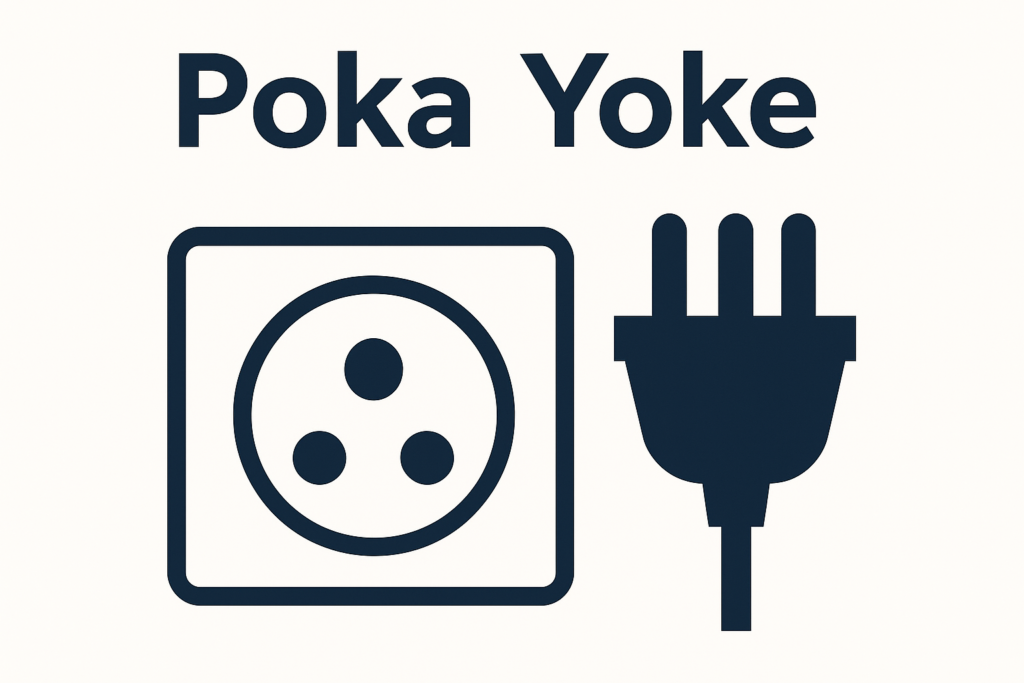
Example: a USB connector that only fits one way. - Detecting the error immediately: if it happens, it’s visible right away, before it causes consequences.
Example: an alert when a mandatory field is left empty in a form.
In both cases, employees don’t need to memorize complex rules or go through heavy checks. The system guides them, supports them, and secures their work.
Concrete Examples
Poka Yoke is everywhere around us, often without us realizing it.
- In daily life: a car beeps when the seatbelt isn’t fastened. A washing machine locks if the water is still hot.
- In manufacturing: drilling templates that prevent holes in the wrong spot. Assembly bins where parts only fit in the correct orientation.
- In services: digital forms that validate data before submission (e.g., a phone number with the correct number of digits).
- In logistics: barcode scanning to check consistency between an order and its preparation.
The genius of Poka Yoke lies in this simplicity: discreet, sometimes obvious, yet transformative.
Tangible Benefits
Implementing Poka Yoke isn’t just about “avoiding mistakes.” It also means:
- Ensuring quality: fewer defects, fewer returns, higher customer satisfaction.
- Cutting hidden costs: every prevented error saves time and money (fewer reworks, fewer checks, fewer disputes).
- Lightening mental load: employees don’t have to “think of everything”—the process helps them.
- Building trust: when employees know their work is safeguarded, they gain confidence and efficiency.
How to Implement Poka Yoke
Poka Yoke is not a technology in itself but a method. It can be applied through a few simple steps:
- Identify frequent errors
Start from the field: what are the recurring mistakes? Where are the sensitive points?
Example: incomplete client files, missing screws in assembly, invoices sent to the wrong recipient. - Understand their causes
Behind every error lies a reason: forgetfulness, distraction, poor ergonomics, unclear interfaces… Finding the cause already points to the solution. - Imagine simple solutions
Poka Yoke thrives on simplicity. A stopper, a color code, a sensor, or an automatic check often does the job. - Test and adjust
A solution that looks perfect on paper may be cumbersome in practice. Test quickly, gather user feedback, and adapt. - Integrate it sustainably
When Poka Yoke works, it becomes a natural part of the process. No constant reminders or retraining needed—the system does the work.
Mistakes to Avoid
Ironically, implementing Poka Yoke can fall into its own pitfalls:
- Too much complexity: a sophisticated but fragile system defeats the purpose.
- Ignoring the field: a solution designed without consulting users will be rejected or bypassed.
- Over-relying on technology: sometimes, simple visual cues like floor markings or colors are enough.
- Forgetting follow-up: an effective Poka Yoke must be maintained, tested, and adapted to process changes.
Beyond the Tool: A Culture
Like Lean, Poka Yoke is not just a toolbox. It’s a mindset: designing processes to make work simpler, safer, and more reliable.
It changes how errors are perceived:
- They are not individual faults, but signals that a process can be improved.
- They are not solved with reminders or sanctions, but with smart design solutions.
Adopting Poka Yoke means strengthening a culture of continuous improvement. It allows teams to work with more peace of mind, less stress, and greater confidence.
Key Takeaways
- Poka Yoke is a simple method to prevent human errors.
- Its principle: either make the error impossible or make it immediately visible.
- It translates into concrete solutions: stoppers, alerts, automatic checks, ergonomic design.
- Benefits are many: quality, cost savings, efficiency, satisfaction.
- Implementation is based on field observation, simplicity, and team involvement.
More than a tool, Poka Yoke is a pragmatic philosophy: make mistakes difficult—or impossible—so teams can focus their energy where they truly create value.