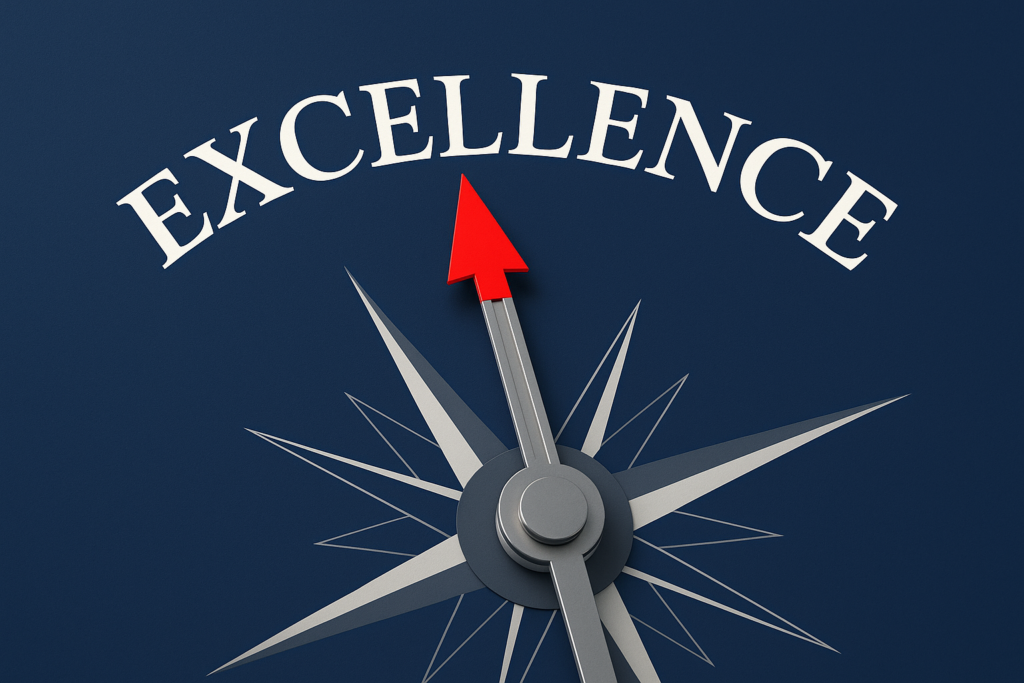
Improving performance, reducing waste, streamlining processes… Operational excellence is often described as a collection of Lean tools, dashboards, and optimization projects.
But behind these methods lies something deeper: a company culture. A way of thinking about work, solving problems, and engaging teams in a shared pursuit of efficiency and lasting quality.
Operational excellence cannot simply be declared. It must be built step by step, close to the field, through everyday actions and shared decisions. It is a living approach, centered on people, where every employee contributes to collective performance.
Why Talk About Operational Excellence?
One truth applies to all organizations: performance no longer depends solely on technical means. Two companies may use the same Lean tools or management software and yet achieve very different results.
The difference lies in culture — in how practices are applied, sustained, and embedded in daily work.
Operational excellence pursues a dual goal: doing better today while preparing for tomorrow.
It goes beyond cost reduction or speed of execution. It aims to build reliable, agile, and sustainable processes.
And above all, it rests on a key idea: it is people who create performance, not tools.
The Foundations of Operational Excellence
Operational excellence is built on simple yet demanding principles.
It starts with process stability — without standards, there can be no improvement. Tasks must be clear, repeatable, and controlled.
It relies on structured problem-solving — every deviation is an opportunity to learn. The goal is not to find someone to blame, but to find the root cause.
Finally, it depends on continuous improvement — rather than launching large-scale projects, it encourages small, steady steps that are tested, measured, and sustained.
In essence, operational excellence is a daily discipline: observe, understand, improve, stabilize.
It turns progress into a collective reflex.
Tools: Necessary but Not Sufficient
Kanban, 5S, Kaizen, VSM, Andon, PDCA, DMAIC… The Lean and Six Sigma toolboxes are vast, and their effectiveness is well established.
But tools are only means to an end. Without understanding and ownership, they lose their value.
A 5S applied without explaining why becomes superficial tidying.
A metric displayed without discussion becomes an empty number.
An improvement project led without the teams becomes a constraint, not an opportunity.
Operational excellence is about bringing tools to life — adapting them, explaining them, and connecting them to the company’s purpose.
A well-used tool structures thinking and empowers teams. A poorly used one adds complexity without creating value.
The Role of Leadership
A culture of excellence doesn’t emerge on its own — it spreads through leadership behavior.
Leaders’ roles go beyond managing indicators. They must create the conditions that allow teams to improve.
A true operational excellence leader:
- observes the field before deciding;
- asks questions rather than imposing answers;
- values progress, even small wins;
- supports initiatives and encourages learning.
At Toyota, this is called servant leadership: to lead is to serve collective progress.
This style of management is essential to turn tools into habits, and habits into culture.
Operational Excellence in Practice
In manufacturing, a workshop implementing an Andon system allows operators to signal problems immediately. This simple act prevents defects from spreading and boosts responsiveness.
In services, a team that standardizes operating procedures reduces errors and waiting times.
In logistics, visualizing flows through a Value Stream Map helps identify bottlenecks and balance workloads.
In digital environments, continuous improvement takes shape through short development cycles, rapid experimentation, and constant user feedback.
In every case, the logic remains the same: observe, simplify, stabilize.
Operational excellence is not a one-time project — it is a sustainable way of organizing work.
Tangible Benefits
Pursuing operational excellence aims at far more than just productivity gains.
It transforms how the organization learns, adapts, and evolves.
The benefits are clear:
- Higher quality: defects are detected earlier and corrected at the source.
- Greater efficiency: processes become smoother and waste is reduced.
- Enhanced customer satisfaction: reliability and responsiveness build trust.
- Stronger team motivation: employees see the direct impact of their contributions.
- Organizational resilience: stable, learning systems adapt faster to change.
In short, operational excellence creates lasting value — for customers, for the business, and for its people.
Common Pitfalls to Avoid
Like any improvement approach, operational excellence can lose its meaning if misunderstood.
Some frequent pitfalls include:
- Focusing solely on tools instead of understanding the philosophy.
- Launching improvement projects without involving frontline teams.
- Chasing quick wins rather than sustainable progress.
- Neglecting training, sharing, and recognition.
- Treating indicators as an end rather than a means.
Excellence cannot be imposed; it must be built.
It grows through trust, consistency, and coherence.
Beyond the Method: A Culture
Operational excellence is not a destination but a journey.
It is a culture of mastery and learning, where everyone contributes to improving collective performance.
It transforms how problems are perceived: they are no longer obstacles, but opportunities for progress.
In this mindset, performance does not come at the expense of people — it strengthens them.
When processes are stable and clear, teams gain autonomy and confidence.
When improvements come from the field, they endure.
Key Takeaways
- Operational excellence is above all a culture, not a toolbox.
- It seeks sustainable performance: quality, efficiency, engagement, and stability.
- Its foundations lie in standardization, observation, and continuous improvement.
- Lean and Six Sigma tools are effective only when understood and shared.
- Proximity leadership is essential to bring this approach to life every day.
- More than a method, operational excellence is a way of thinking, learning, and working together.