
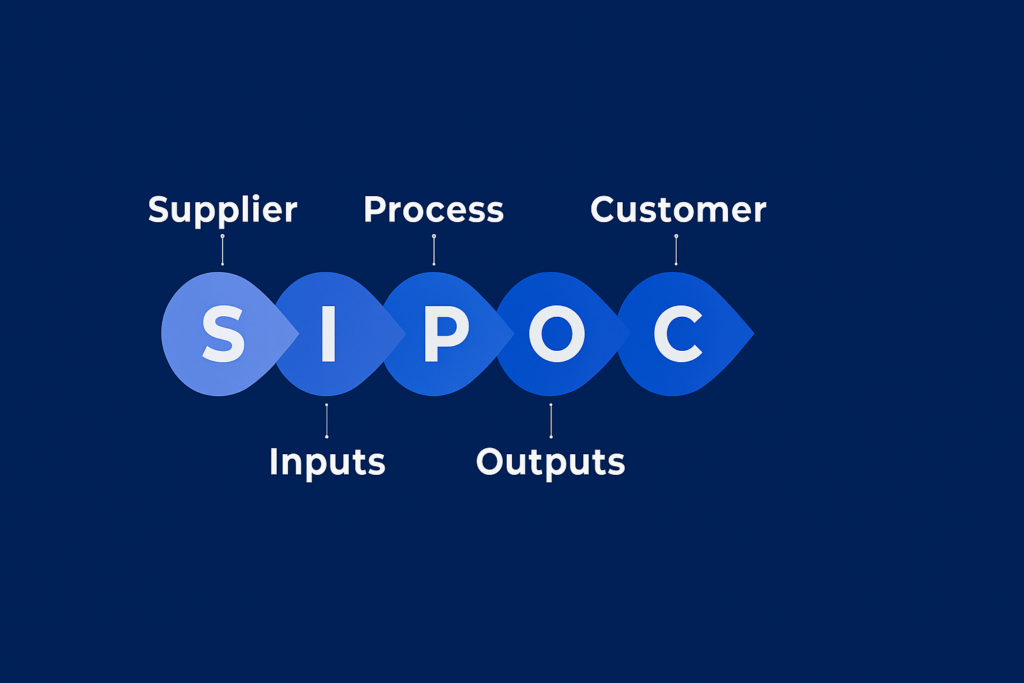
Visualizing a process in a clear, shared, and structured way — that’s the essence of SIPOC.
Neither a tool reserved for Lean Six Sigma experts nor a complex diagram to build, SIPOC is a simple, accessible, and highly effective method for understanding how a process works — from supplier to customer, through each key step.
The term SIPOC is an acronym:
- S for Suppliers
- I for Inputs
- P for Process
- O for Outputs
- C for Customers
The idea is straightforward: represent the entire transformation system — from need to result — in a single view. In just a few lines, a SIPOC shows who provides what, how the work is done, and who receives the outcome.
It’s often the starting point of any continuous improvement project. Before measuring, analyzing, or changing a process, it must first be understood. SIPOC provides that foundation: a shared language, a common vision, and a clear understanding of interactions.
Why Use a SIPOC
In many organizations, processes are known — but rarely formalized.
Each department has its own vision, priorities, and constraints. The result? Misunderstandings, duplication, and inefficiency.
SIPOC acts as a compass. It helps to:
- Clarify the boundaries of a process (where it starts and ends)
- Align teams around a shared understanding
- Identify key stakeholders (suppliers, internal or external customers)
- Quickly spot pain points and grey areas
- Prepare for deeper analysis (detailed mapping, VSM, DMAIC, etc.)
It’s also a powerful communication tool. On a single page, everyone — management, operations, and support functions — speaks the same language.
The Principle of SIPOC: Seeing the Whole Before the Details
One of SIPOC’s greatest strengths is its visual simplicity.
Before diving into the complexity of a process, it invites teams to step back and see the overall flow rather than micro-tasks.
It starts with a few essential questions:
- What is the purpose of this process?
- What results should it produce?
- Who are the customers of these results?
- What data, materials, or information enter the process?
- And finally, what are its key steps?
Answering these five questions provides a clear view of how the process truly operates.
The 5 Simple Steps to Build a SIPOC
Define the Process (P)
Curiously, a SIPOC doesn’t start with “S” but with “P.”
The heart of the method is the process itself.
Before talking about suppliers or customers, you must first define the scope:
Where does the process start?
Where does it end?
What are the main intermediate steps?
The goal isn’t detail, but flow logic.
A SIPOC typically includes 5 to 7 key steps — from input to output.
Example: In a recruitment process:
- Receive recruitment request
- Validate the need
- Publish the job posting
- Select candidates
- Conduct interviews and make a decision
The goal: make the flow visible in a few lines, without getting lost in operational details.
Identify the Outputs (O)
Once the process is defined, focus on what it produces — the outputs.
Outputs are the tangible results of the process. They may include:
- A physical product
- A service delivered
- A document, data, or validated information
- A decision made or a satisfied customer
These outputs must be measurable and assessable. They will later serve as performance indicators.
Example: In recruitment, the output could be a hired candidate or a filled position.
Identify the Customers (C)
Customers are those who receive the process outputs. They can be:
- External: the company’s end customers
- Internal: another department, management, or employee
The goal is to understand their expectations — in terms of time, quality, format, and frequency.
A process must always be designed around customer needs, not internal convenience.
This step is key to refocusing the analysis: a process only makes sense if it creates value for its customer.
Identify the Inputs (I)
Now move upstream in the flow.
Inputs are the elements required for the process to function: raw materials, data, information, requests, forms, or instructions.
Ask yourself:
- What inputs are essential at each step?
- Are they always available, correct, and complete?
- Are there delays or errors caused by missing or incorrect inputs?
Example: For recruitment, the inputs might include the manager’s request, the job description, and the approved budget.
Identify the Suppliers (S)
Finally, determine who provides these inputs.
Suppliers may include internal departments (HR, IT, logistics, production) or external partners (vendors, service providers, upstream clients).
The goal is to make dependencies visible and identify improvement levers.
A strong process relies on a clear, reliable, and collaborative supply chain.
Example: In recruitment, suppliers might include the department manager, finance (for budget validation), or job boards.
Practical Examples of SIPOC
SIPOC applies to all contexts:
- In industry: to formalize production steps and key control points
- In services: to streamline handoffs between departments (e.g. marketing ↔ sales ↔ customer service)
- In digital: to structure information flows (e.g. customer support or IT incident management)
- In logistics: to clarify physical and documentary flows
Whatever the field, SIPOC is a cross-functional dialogue tool, an analytical support, and a foundation for any improvement initiative.
Concrete Benefits
Implementing SIPOC means:
- Clarifying responsibilities — everyone knows what they deliver and receive
- Reducing blind spots — service interfaces become visible
- Aligning teams around a common understanding of the process
- Saving time during diagnostics and improvement projects
- Fostering collaboration among internal and external stakeholders
It’s also a simple way to lay the groundwork for Lean Six Sigma before moving on to more advanced tools like VSM or DMAIC.
Common Mistakes to Avoid
Like any Lean tool, SIPOC loses its value if misunderstood.
Common pitfalls include:
- Too much detail — SIPOC is not a procedure; it must remain concise
- A fuzzy scope — unclear boundaries lead to overlaps or omissions
- Forgetting the customer — a process that ignores end-user needs misses its purpose
- Working in isolation — a SIPOC must be built collaboratively with field teams
Key Takeaways
- SIPOC is a simple tool for mapping a process from supplier to customer
- It is built in 5 steps: Process → Outputs → Customers → Inputs → Suppliers
- It helps clarify, align, and diagnose before launching improvements
- Its power lies in simplicity, collaboration, and a global vision
- More than a diagram, SIPOC is a shared understanding tool — a solid foundation for any operational excellence journey